Reference
The five ship classes in World of Warships
Links and buttons marked partner link are advertising. If you follow one and sign up, BoscanisOne s.r.o. receives a commission from the advertiser. You pay nothing extra, and the price or terms you are offered are exactly the same as if you had gone to the game’s own site directly.
Being paid does not buy a favourable write-up. What the commercial relationship does and does not allow is set out in our editorial policy.
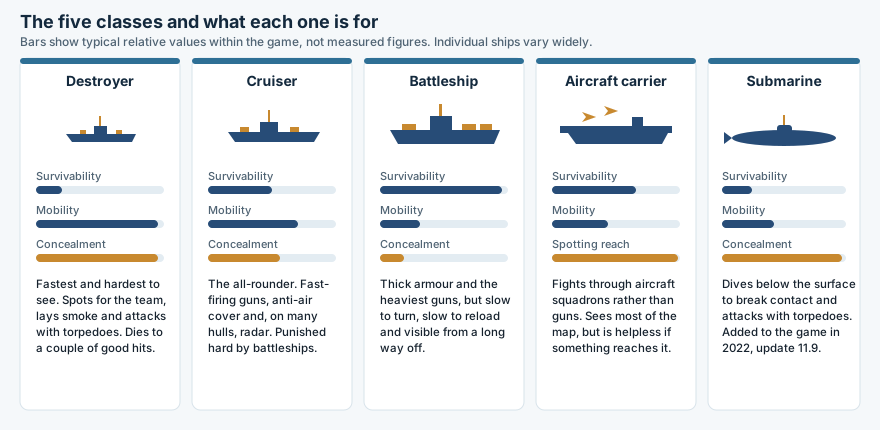
Class matters more than nation for a new player. Each of the five classes has a different job, a different failure mode and a different set of ships that beat it. This page covers all five in order of how approachable they are.
Battleship
The job: absorb damage at the front of a flank and delete anything that shows its side.
Battleships carry the heaviest guns in the game, firing in salvoes with reloads measured in the twenties or thirties of seconds. They also carry the thickest armour and a Repair Party consumable that restores part of the damage they have taken. A battleship that angles properly, uses islands and does not overextend can hold a flank more or less on its own.
The failure mode: impatience. Battleships turn slowly and cannot disengage quickly. A battleship that has pushed too far forward cannot get back, and it will be set on fire from three directions while it tries.
Beaten by: destroyers with torpedoes at close range, cruisers spamming high explosive from behind islands, aircraft. Good first class? Yes — the reload gives you time to think, and mistakes are survivable.
Cruiser
The job: everything else. Kill destroyers, provide anti-aircraft cover, set battleships on fire, take capture areas.
Cruisers fire fast, turn well and carry the widest range of consumables — radar, hydroacoustic search, defensive anti-aircraft fire, and on light cruisers often a smoke generator. They are the most useful class to have on a team and the most demanding to keep alive, because they have enough armour to be shot at and not enough to survive being shot at properly.
The failure mode: being caught broadside by a battleship at fifteen kilometres. One salvo is frequently enough.
Beaten by: battleship armour-piercing shells, aircraft if isolated. Good first class? Yes, at mid tiers — you will learn more about the game per battle than in any other class.
Destroyer
The job: vision. A destroyer tells its team where the enemy is, contests capture areas, and threatens anything that pushes into a narrow channel with torpedoes.
Destroyers are the fastest ships in the game and the hardest to detect, often invisible until around six kilometres. They carry smoke generators, torpedoes with long reloads, and guns that range from nearly useless to genuinely dangerous depending on the nation.
The failure mode: radar. A destroyer sitting in a capture area when an enemy radar cruiser comes into range is revealed to the whole enemy team, with no cover, in a ship that has very little health.
Beaten by: radar cruisers, other destroyers with better guns, aircraft. Good first class? Not really. The class is rewarding but unforgiving, and it depends on map knowledge you do not have yet.
Aircraft carrier
The job: spot for the team and deliver attacks anywhere on the map.
Carriers are played differently from everything else. You control squadrons of attack aircraft directly, flying them to a target and making attack runs, while your ship sails on autopilot at the back. You see more of the map than any other player and have the least influence over the gun fight going on around your own hull.
The failure mode: being found. A carrier that a destroyer reaches is essentially defenceless.
Beaten by: concentrated anti-aircraft fire, and anything that gets within gun range of it. Good first class? No. It is effectively a separate game, and playing it badly is very noticeable to eleven other people.
Submarine
The job: approach unseen and attack with torpedoes.
Submarines were added to the game with Update 11.9 in 2022. They can dive below the surface, which breaks most detection and most weapons, at the cost of a limited air supply and reduced speed and visibility. They are the newest class and have been rebalanced repeatedly since introduction; expect their details to be different from any guide written more than a few months ago.
The failure mode: surfacing at the wrong moment, or running out of air next to a destroyer.
Beaten by: destroyers and cruisers with depth charges and hydroacoustic search. Good first class? No — for the same reason as carriers, plus the added problem that the class changes often.
A short answer, if you just want one
Start in a mid-tier cruiser or battleship, in co-operative battles, in the nation whose ships you think look best. That last criterion is not a joke: you will play a line for a long time, and enjoying the ships matters more than any statistical edge you could pick instead.
Start with a cruiser or a battleship
Both lines are free to research from tier one, and the game is free to install.
Open the offerPartner link — advertisingPartner link. If you register through it, BoscanisOne s.r.o. is paid a commission by the advertiser. It costs you nothing extra and does not change the terms you are offered.Trademark notice. “World of Warships”, “Wargaming” and all related names, logos, ship names and images are trademarks or registered trademarks of their respective owners. This site is an independent publication. It is not affiliated with, endorsed by, sponsored by or otherwise connected to Wargaming or any of its group companies. All references are made for identification and descriptive purposes only.
The diagram on this page is an original vector illustration created for borislavik.online.