Naval strategy · Game guide
World of Warships: what the game actually is, and what it asks of you
Links and buttons marked partner link are advertising. If you follow one and sign up, BoscanisOne s.r.o. receives a commission from the advertiser. You pay nothing extra, and the price or terms you are offered are exactly the same as if you had gone to the game’s own site directly.
Being paid does not buy a favourable write-up. What the commercial relationship does and does not allow is set out in our editorial policy.
World of Warships is a free-to-play naval combat game in which up to twelve players a side command historical and near-historical warships across open water. It is slower than most online shooters, more like a game of chess played at fifteen knots, and it rewards patience far more than reflexes. This guide explains how the game is structured, which mechanics decide fights, what the free-to-play model really costs, and who tends to enjoy it.
On this page
What World of Warships is
World of Warships was released for Windows on 17 September 2015 and is developed and published by Wargaming. It is a team-based naval game: you take a single warship into a match against a team of other players, and the battle is resolved by gunnery, torpedoes, aircraft and position. There is no building, no base management and no campaign in the single-player sense — the entire game is the match, repeated.
The ships are drawn from roughly the first half of the twentieth century, from pre-dreadnought-era hulls at the bottom of the tree to late and unbuilt designs at the top. Several are ships that were laid down and never finished, or paper designs that existed only as drawings; the game is not a simulation and does not claim to be. Tech trees cover the United States, Japan, the Soviet Union, Germany, the United Kingdom, France, Italy, the Netherlands, Spain, Pan-Asia, Pan-America, the Commonwealth and a combined European tree, with the exact line-up changing as updates add and rearrange ships.
Two related but separate products share the name: World of Warships: Legends, the console and mobile version, and World of Warships Blitz on mobile. They are different games with different balance and different accounts. Everything on this page refers to the PC game.
Download and play World of Warships
Free to download on Windows. You can be in your first battle within about twenty minutes of starting the installer.
Go to the offerPartner link — advertisingPartner link. If you register through it, BoscanisOne s.r.o. is paid a commission by the advertiser. It costs you nothing extra and does not change the terms you are offered.The five ship classes
Every ship in the game belongs to one of five classes, and the classes are genuinely different to play — not variations on a theme. Choosing a class you enjoy matters more for your first hundred battles than choosing a nation.
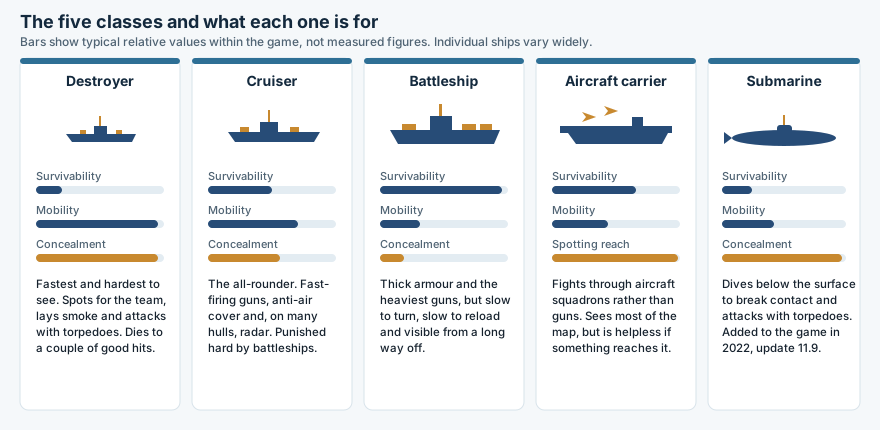
- Destroyers are small, fast and very hard to see. They spot for the team, lay smoke screens and attack with torpedoes. They also die to a couple of well-aimed salvoes, so a destroyer player spends most of the match deciding when not to be seen.
- Cruisers sit in the middle. Fast-firing guns, real anti-aircraft cover for the team and, on many hulls, the radar consumable. They are flexible and constantly in demand, and a battleship salvo will delete one that shows its side.
- Battleships have the thickest armour and the heaviest guns, reloading over roughly half a minute. They are slow to turn, visible from a long way off, and they punish other ships severely for a single mispositioned moment.
- Aircraft carriers fight through squadrons of attack aircraft rather than guns. They see more of the map than anyone else and have the least direct control over the fight in front of them. They are also the most divisive class in the game among long-term players.
- Submarines were added to the game with Update 11.9 in 2022. They dive below the surface to break contact and attack with torpedoes, and they remain the newest and most frequently rebalanced class.
Tiers, tech trees and progression
Ships are graded from tier I to tier X. You start at the bottom of a national line, earn experience in the ship you are flying, spend that experience to research the next ship in the line, and then spend credits to buy it. Above tier X sit superships, marked with a star, which are unlocked from a tier X ship rather than bought outright.
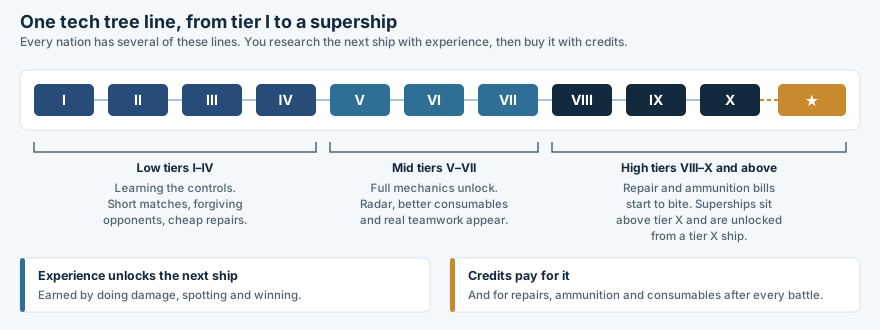
Two things surprise new players about this structure. The first is that matchmaking usually puts you against ships one tier above your own, so a tier VI ship regularly fights tier VII. The second is that running costs rise faster than earnings as you climb: a bad match in a tier X ship can cost you more credits than it pays, which is why most experienced players keep a mid-tier ship for grinding money.
There is no shortcut that skips the learning. There are shortcuts that skip the grinding — see the economy section — and they are the main thing the game sells.
How a battle unfolds
A standard random battle runs on a clock of about twenty minutes and a points total. A team wins by destroying every enemy ship, by reaching the points cap first — points accrue from holding capture areas and from kills — or simply by being ahead when the clock runs out. The three base map modes are Standard, with one base per side, Domination, with several contested capture areas, and Arms Race, which adds buff zones.
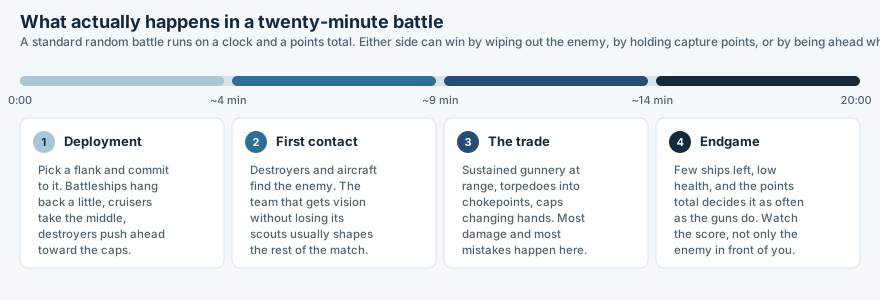
The single most common way for a new player to lose a battle is to treat it as a deathmatch and ignore the score. Battles are lost on points far more often than people expect, particularly when one flank collapses early and the enemy sits on capture areas while your team chases kills elsewhere.
The mechanics that decide fights
Concealment and spotting
Nothing in World of Warships matters more than who can see whom. Every ship has a detectability range, shown in the port as a distance in kilometres, and it becomes visible to the enemy the moment an enemy ship or aircraft comes inside that radius. A destroyer might be invisible until around six kilometres; a battleship may be detectable from more than fifteen. There is a separate, usually larger, radius for detection by aircraft.
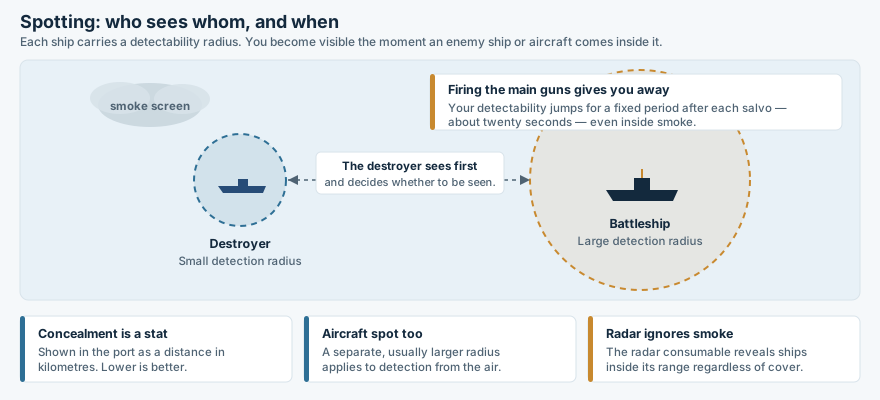
Two consequences follow. First, firing your main battery reveals you for a fixed period afterwards — about twenty seconds — even inside a smoke screen, which is why a ship shooting from smoke can still be shot back at. Second, the radar consumable ignores smoke and terrain entirely, revealing every ship inside its radius for its duration. Radar is the reason destroyers cannot simply sit in a capture area with impunity, and knowing which ships in the enemy line-up carry it is a genuine skill.
Shell types, citadels and angling
Main guns fire two kinds of shell. High explosive bursts on the outside of the target: modest damage, but it starts fires and breaks modules, and it works against armour too thick to penetrate. Armour piercing passes through the plate and detonates inside; if it reaches the citadel — the armoured box around the engines and magazines — the damage is enormous.
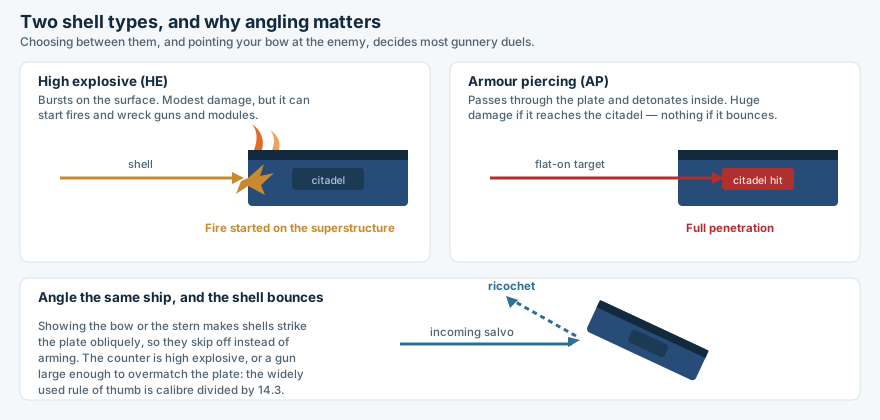
This is why angling is the first real skill a player learns. Pointing your bow or stern at an enemy makes their armour-piercing shells strike your plating obliquely, and they ricochet instead of arming. Showing a full broadside at range is the single most punished mistake in the game. The counters to an angled target are high explosive, torpedoes, or a gun large enough to overmatch the plate — the widely used community rule of thumb is that a shell overmatches armour thinner than its calibre divided by 14.3.
Consumables
Each ship carries a small set of activated consumables on cooldown, and using them at the right moment is most of what separates a good player from an average one.
| Consumable | What it does | Usually carried by |
|---|---|---|
| Damage Control Party | Clears fires, flooding and module damage | Every ship |
| Repair Party | Restores part of the health you have lost | Battleships, many cruisers |
| Smoke Generator | Lays a cloud that blocks line of sight | Destroyers, some cruisers |
| Hydroacoustic Search | Detects ships and torpedoes through smoke at short range | Cruisers, destroyers |
| Surveillance Radar | Reveals ships in radius regardless of smoke or terrain | Many cruisers, some destroyers |
| Defensive AA Fire | Sharply increases anti-aircraft damage | Cruisers, some battleships |
| Engine Boost | Temporary increase in top speed | Destroyers, some cruisers |
Game modes
Random battles are the main mode, but they are not the only way in, and they are not the gentlest.
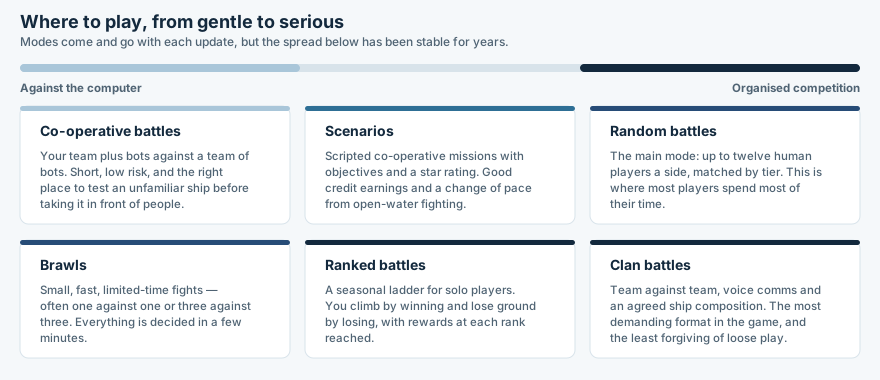
If you are new, spend your first few evenings in co-operative battles and scenarios. They pay reasonably, they are short, and they let you learn a ship’s turning circle and reload without twenty-three other people watching.
The free-to-play economy
The game is free to download and free to play to tier X. It makes its money in four ways, and it is worth understanding all four before you spend anything.
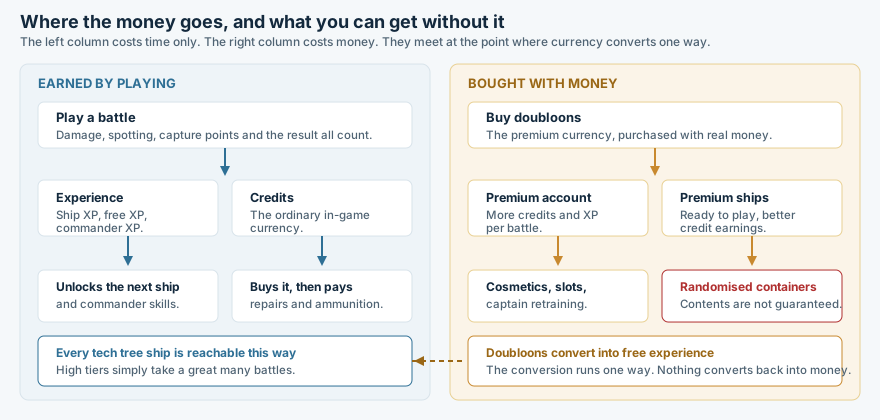
- Premium account — a time-limited subscription that increases the credits and experience you earn per battle. This is the purchase most regular players make, because it shortens the grind rather than changing the fight.
- Premium and special ships — individual ships sold for money or for in-game resources. They come fully researched, earn more credits, and do not require their own captain retraining. Wargaming’s stated intent is that they are balanced to be side-grades rather than upgrades; whether that always holds in practice is a matter of long and genuine disagreement among players.
- Doubloons — the premium currency, bought with money and spent on the above, on cosmetics, port slots and captain retraining, and on converting accumulated ship experience into free experience.
- Containers — randomised reward crates. Some are earned by playing; others are sold. Where they are sold, the contents are not guaranteed, and you should treat them the way you would treat any other paid randomised reward.
A plain warning. Paid randomised containers are, functionally, a gamble. Several European regulators have taken an interest in mechanics of this kind. If you intend to spend money on this game, buying a specific ship or a premium account gives you a known thing for a known price; containers do not. Set a budget before you start rather than after.
Is it pay-to-win?
This deserves an honest answer rather than a marketing one. Money cannot buy you a shot that cannot miss, and no purchase makes you invisible or invulnerable. What money buys is time: a premium account and premium ships shorten a grind that is otherwise measured in hundreds of hours, and free experience conversion lets you skip ships in a line you dislike.
The honest complication is that some premium ships have, at various points in the game’s history, been widely considered stronger than their tech tree equivalents, and Wargaming has rebalanced several of them after the fact. Whether that amounts to pay-to-win is a judgement call. What is not in dispute is that a skilled player in a free tech tree ship regularly beats an unskilled player in an expensive one.
Platforms and requirements
The PC game runs on Windows. Wargaming previously offered a macOS wrapper, which has since been discontinued. The client is a substantial download — tens of gigabytes — and grows with each major update, so check your free disk space before you start rather than halfway through.
We are deliberately not reproducing a table of minimum and recommended system specifications here. Those figures change with almost every major update, and a stale specification table is worse than none. The current requirements and the current age rating are published on the game’s own download page, and that is the authoritative source.
Common beginner mistakes
- Sailing in a straight line. Shells take several seconds to arrive and the enemy is aiming where you will be. Change speed and heading, even slightly, and a large share of incoming fire simply misses.
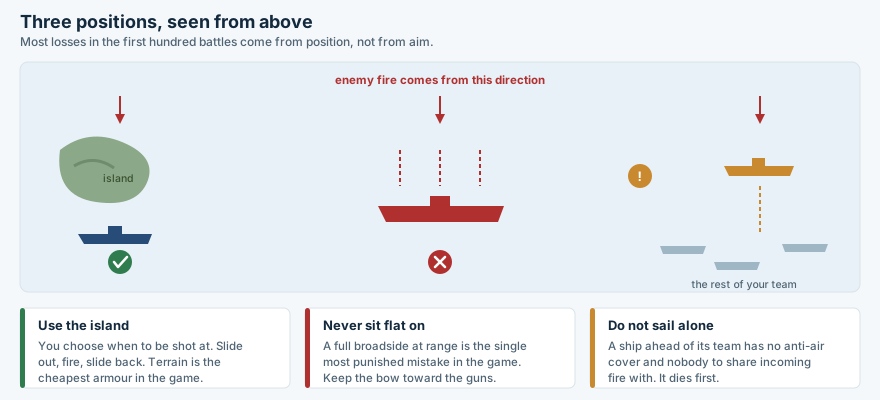
- Showing your broadside. Covered above, and worth repeating, because it is the mistake that ends the most battles early.
- Sailing alone. A ship ahead of its team has no anti-aircraft cover and nobody to share incoming fire with. It dies first, and then its team is one ship down.
- Firing at everything. Every salvo lights you up. Shooting at a target you cannot meaningfully hurt, while three ships that can hurt you get a bearing on your position, is a bad trade.
- Climbing tiers too fast. The game becomes less forgiving and more expensive as you climb. Players who rush to tier X on free experience tend to have a miserable time when they arrive.
- Ignoring the minimap. It is the most useful thing on the screen and the thing new players look at least.
A structured plan for your first twenty battles is on the beginner’s guide page.
Who it suits
World of Warships suits people who like thinking slowly under pressure: reading a map, judging when to commit, accepting that a good decision sometimes still loses. It suits people with an interest in naval history, because the ships are recognisable and the game is generous with detail. It also suits an evening where you want three or four self-contained twenty-minute games rather than a session.
It suits you less if you want fast reflexive action, if being dependent on eleven strangers frustrates you, or if you dislike progression systems that are explicitly designed to be shortened with money. Those are real properties of the game, not complaints about it, and knowing them in advance is better than discovering them at tier VIII.
Ready to try it?
The game is free to install and free to play. Nothing on this page requires you to spend anything.
Open the offerPartner link — advertisingPartner link. If you register through it, BoscanisOne s.r.o. is paid a commission by the advertiser. It costs you nothing extra and does not change the terms you are offered.Sources and corrections
This article was written by Anthony Smith and published on 22 September 2026. Factual points — the release date, the developer and publisher, the class list, the tier structure and the introduction of submarines — were checked against the sources below. Mechanical descriptions reflect long-documented in-game systems; figures given as rules of thumb are identified as such in the text.
- Official game site: worldofwarships.eu — for current system requirements, age rating, pricing and update notes.
- Wikipedia, World of Warships — for release date, platform history and the introduction of submarines in Update 11.9.
The publisher’s own information prevails. World of Warships is updated frequently and its balance, economy, modes and requirements change with it. Where anything on this page diverges from Wargaming’s own published information or from the game client itself, Wargaming’s information is correct and this page is not. If you find an error here, write to info@borislavik.online and we will correct it — our corrections procedure explains how.
Trademark notice. “World of Warships”, “Wargaming” and all related names, logos, ship names and images are trademarks or registered trademarks of their respective owners. This site is an independent publication. It is not affiliated with, endorsed by, sponsored by or otherwise connected to Wargaming or any of its group companies. All references are made for identification and descriptive purposes only.
All diagrams on this page are original vector illustrations created for borislavik.online. They are schematic: they explain relationships and trade-offs and are not screenshots, scale drawings or measurements taken from the game.